
| False Lime |

|
 |

|


| File size | 2468349 |
| Original date | 4/4/09 4:25 PM |
| Resolution | 2560 x 1920 |
| Flash | Flash did not fire, auto |
| Focal length | 25.9mm |
| Exposure time | 1/100s |
| Aperture | 4.0 |
| Focus Distance | |
| Metering Mode | Multi-segment |
| Camera make | Panasonic |
| Camera model | DMC-FZ18 |
| Sensor type | OneChipColorArea |
 |
 ative ative |
 |
 |
Photo: |
Botanical name: Suregada multiflora Family: Euphorbiaceae (Castor family)
Synonyms: Gelonium multiflorum
Synonyms: Gelonium multiflorum
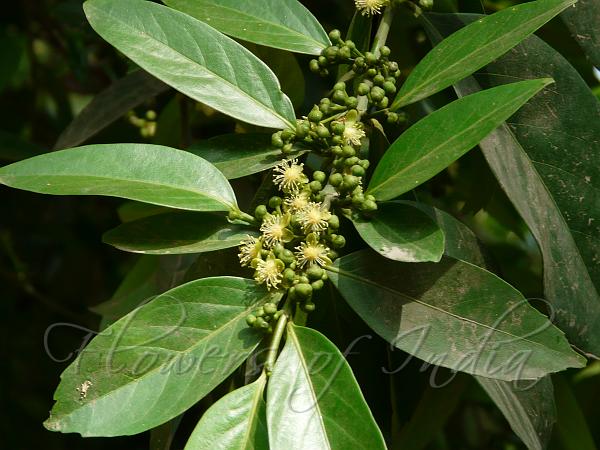
False Lime is a tall shrub or a small trees, growing 2-13 m tall, native to NE India. Branches
are gray-yellow to gray-brown, hairless. Leaf stalks are 3-12 mm long.
Leaf blade is obovate-elliptic to obovate-lanceshaped or oblong-elliptic,
5-16 cm long, 3-8 cm wide, somewhat leathery, with a pointed tip. Flowers
are borne in short stalked cymes. Flowers are tiny, 5-8 mm across, male
and female flowers separate on the same tree. Male flowers have circular
sepals, with 30-60 stamens. Female flowers have an annular disk, and a
spherical ovary. Sepals are persistent on the fruit, which is round, 1.1-1.5
cm across, slightly fleshy, 3-seeded. False Lime is found from NE India to
China and SE Asia. Flowering: March-September.
Medicinal uses: False lime is utilized to treat gum and hepatic ailments in traditional
medicines. In Thailand, it is utilized to treat skin diseases including
rashes, itching, and inflammation. In India, the seeds of S. multiflora
are utilized in the treatment of liver diseases and as a gum tonic.
False lime is utilized to treat gum and hepatic ailments in traditional
medicines. In Thailand, it is utilized to treat skin diseases including
rashes, itching, and inflammation. In India, the seeds of S. multiflora
are utilized in the treatment of liver diseases and as a gum tonic.
Medicinal uses:
False lime is utilized to treat gum and hepatic ailments in traditional
medicines. In Thailand, it is utilized to treat skin diseases including
rashes, itching, and inflammation. In India, the seeds of S. multiflora
are utilized in the treatment of liver diseases and as a gum tonic.
| Identification credit: Tabish | Photographed in Sundar Nursery, Delhi & Bada Botla forest, Jharkhand. |
• Is this flower misidentified? If yes,